🧬 Book DNA
- 🧠 Mood: Dark • Tense • Inspiring • Informative
- 🚀 Pacing: Fast-paced / Page-turner
- 🧩 Complexity: Moderate
- 🎯 Perfect For: Deep Thinking • Gift • Escapism
📑 Table of Contents
- The Premise: Two Men, One Destiny. The Devil in the White City review.
- The White City: Building a Dream. The Devil in the White City review.
- The Black City: The Murder Castle. The Devil in the White City review.
- Writing Style and Atmosphere. The Devil in the White City review.
- Critical Reception. The Devil in the White City review.
- Why This Book Matters. The Devil in the White City review.
- Final Verdict
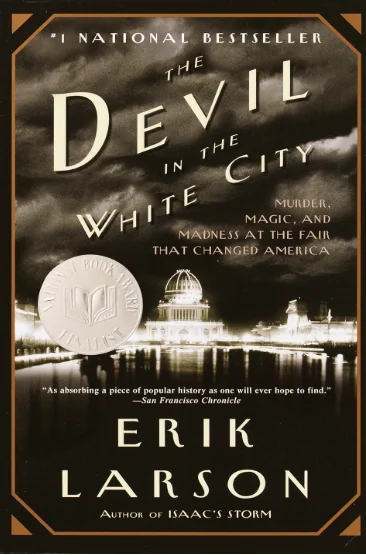
In this comprehensive The Devil in the White City review, we delve into one of the most acclaimed non-fiction books of the last thirty years. It is a story of two men, two cities, and the thin line between genius and madness.
#1 NATIONAL BESTSELLER • NATIONAL BOOK AWARD FINALIST
A Kirkus Reviews Best Nonfiction Book of the Century • A Los Angeles Times Best Nonfiction Book of the Last 30 Years
Depending on who you ask, the Chicago World’s Columbian Exposition of 1893 was either the greatest display of human ingenuity in history, or the setting for the most horrific crimes the United States had ever seen. In The Devil in the White City, Erik Larson proves that it was both.
Combining meticulous research with nail-biting storytelling, Larson has crafted a narrative with all the wonder of newly discovered history and the thrills of the best fiction. If you are a fan of history, true crime, or architecture, this book is not just recommended—it is essential.
The Premise: Two Men, One Destiny. The Devil in the White City review.
The brilliance of Larson’s book lies in its dual narrative. He tells two parallel stories that rarely intersect in person but are inextricably linked in spirit. Two men, each handsome and unusually adept at his chosen work, embodied an element of the great dynamic that characterized America’s rush toward the twentieth century.
- The Creator: Daniel Hudson Burnham, the brilliant Director of Works. He was the architect responsible for turning a swampy wasteland into the “White City,” a neoclassical dreamscape that would redefine American cities forever.
- The Destroyer: Henry H. Holmes, a young, charming doctor. In a malign parody of the White City, he built his own structure just west of the fairgrounds—a “World’s Fair Hotel” that was actually a torture palace complete with a gas chamber and a crematorium.
This juxtaposition is the heartbeat of the book. While Burnham fights against time, weather, and labor unions to build something beautiful, Holmes uses that very beauty as bait to lure victims to their deaths.
The White City: Building a Dream. The Devil in the White City review.
For readers interested in history, the sections dedicated to Daniel Burnham are fascinating. The 1893 World’s Fair was not just a carnival; it was America’s attempt to prove to the world (and specifically to Paris, which had just unveiled the Eiffel Tower) that it was a cultural superpower.
Burnham overcame tremendous obstacles and tragedies. He had to organize the massive talents of landscape architect Frederick Law Olmsted (the creator of Central Park), Charles McKim, Louis Sullivan, and others. They had to transform the swampy Jackson Park into a gleaming city of white plaster and electric lights.
Larson captures the sheer scale of the anxiety. Would the buildings collapse? Would the Ferris Wheel—the American answer to the Eiffel Tower—actually turn? The book draws the reader into the enchantment of the Gilded Age, showing how this event introduced the world to things we take for granted today, from shredded wheat to the Pledge of Allegiance.
The Black City: The Murder Castle. The Devil in the White City review.
If Burnham’s story provides the awe, H.H. Holmes provides the terror. This The Devil in the White City review would be incomplete without discussing the antagonist who makes this book a staple of the true crime genre.
Holmes is terrifying not because he is a monster, but because he is a gentleman. He used the attraction of the great fair and his own satanic charms to lure scores of young women to their deaths. He arrived in Chicago and built a pharmacy with a hotel on the upper floors.
But this was no ordinary hotel. It was a complex maze designed to confuse and trap. It featured:
- Soundproof vaults.
- Gas jets in the bedrooms controlled from the owner’s office.
- A greased chute leading directly to the basement.
- A basement equipped with a dissection table and a 3,000-degree crematorium.
What makes the story all the more chilling is that Holmes really lived. He walked the grounds of that dream city by the lake, perhaps even brushing shoulders with Burnham. He represents the dark underbelly of urbanization—the idea that in a modern city full of strangers, a killer can hide in plain sight.
Writing Style and Atmosphere. The Devil in the White City review.
Critics have universally praised Larson’s ability to turn dry facts into a gripping drama. As the Chicago Sun-Times noted, Larson is a “historian with a novelist’s soul.”
The book is engrossing and exceedingly well documented. Larson draws the reader into the atmosphere of 1893 Chicago—the smoke, the noise, the smell of the stockyards, and the dazzling brightness of the new electric lights at the Fair.
The narrative is made all the more appealing by a supporting cast of real-life characters who make cameos, including:
- Buffalo Bill Cody, whose Wild West show set up shop right outside the fair.
- Theodore Dreiser and Susan B. Anthony.
- Thomas Edison and Nikola Tesla, battling over whose electricity would power the fair.
- Archduke Francis Ferdinand, whose visit foreshadows the war to come.
Critical Reception. The Devil in the White City review.
The book has received overwhelming acclaim, cementing its place as a modern classic.
“As absorbing a piece of popular history as one will ever hope to find.” — San Francisco Chronicle
“A dynamic, enveloping book…. Relentlessly fuses history and entertainment to give this nonfiction book the dramatic effect of a novel…. It doesn’t hurt that this truth is stranger than fiction.” — The New York Times
“So good, you find yourself asking how you could not know this already.” — Esquire
Why This Book Matters. The Devil in the White City review.
The Devil in the White City is more than just a story about a fair and a killer. It paints a dazzling picture of the Gilded Age and prefigures the American century to come. It captures a moment of transition—when America moved from a rural nation to an urban industrial power.
It explores the theme of anonymity. The World’s Fair brought millions of strangers together, creating a cover for a predator like Holmes. It is a stark reminder that great progress often comes with great darkness.
Final Verdict
In conclusion, our The Devil in the White City review gives this book a perfect score. It manages to educate without being boring and terrify without being gratuitous.
If you have ever been fascinated by the “True Crime” genre, this is the book that set the standard for modern narrative non-fiction. It is a masterpiece of storytelling that will stay with you long after you turn the final page.
If you enjoy historical narratives that read like thrillers, be sure to check out our other reviews in the History & Thriller section.