🧬 Book DNA
- 🧠 Mood: Dark • Inspiring • Provocative • Informative
- 🚀 Pacing: Fast-paced / Page-turner
- 🧩 Complexity: Moderate
- 🎯 Perfect For: Deep Thinking • Gift • Career Growth
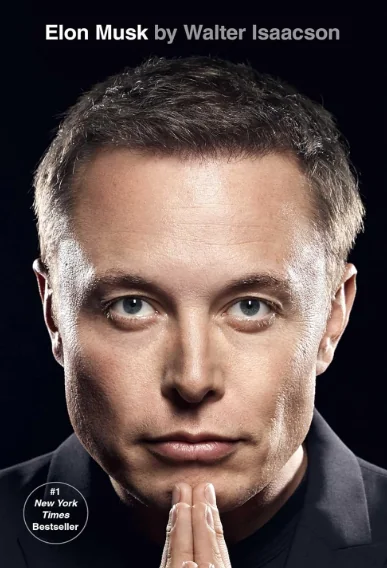
In this extensive Elon Musk by Walter Isaacson review, we explore the definitive portrait of the most fascinating and controversial innovator of our era.
From the author of Steve Jobs and Leonardo da Vinci comes a book that asks the ultimate question: are the demons that drive Elon Musk also what it takes to drive innovation and progress? For two years, Walter Isaacson shadowed Musk, attended his meetings, walked his factories, and interviewed his adversaries. The result is an astonishingly intimate story of triumph, turmoil, and the “demon mode” that changes the world.
#1 NEW YORK TIMES AND GLOBAL BESTSELLER
If you are searching for an honest Elon Musk by Walter Isaacson review that analyzes whether the book lives up to the hype, you have come to the right place. Let’s dive in.
The Origin Story: Scars That Never Healed
To understand the man who wants to colonize Mars, you must first understand the boy who grew up in South Africa. A crucial part of any Elon Musk by Walter Isaacson review is understanding the context of his childhood, which was defined by violence—both physical and emotional.
The physical pain was real. In one particularly disturbing anecdote, a group of bullies pushed young Elon down a flight of concrete steps and kicked him until his face was a “swollen ball of flesh.” He remained in the hospital for a week.
However, as Isaacson notes, the physical scars were minor compared to the emotional ones inflicted by his father, Errol Musk. Described as an engineer, rogue, and charismatic fantasist, Errol’s impact on Elon’s psyche would linger for decades. This trauma developed Elon into a “tough yet vulnerable man-child,” prone to abrupt Jekyll-and-Hyde mood swings.
This context is crucial. It explains Musk’s exceedingly high tolerance for risk and his constant craving for drama. He didn’t just survive chaos; he learned to thrive in it.
The “Demon Mode”: A Management Style?
One of the most talked-about concepts in this Elon Musk by Walter Isaacson review is what the singer Grimes calls “demon mode.” It is a state of maniacal intensity that Musk enters when he feels a sense of urgency—which is almost always.
Isaacson shadows Musk through several of these periods. He documents how this intensity can be callous and at times destructive to the people around him. Yet, the book poses a difficult question: Would Tesla have survived without it?
At the beginning of 2022, after a year where SpaceX launched thirty-one rockets into orbit and Tesla sold a million cars, becoming the most valuable car company on earth, Musk spoke ruefully about this compulsion.
“I need to shift my mindset away from being in crisis mode, which it has been for about fourteen years now, or arguably most of my life,” Musk admitted.
But as Isaacson reveals, this was a wistful comment, not a resolution. Peace unsettles Musk. When things are calm, he creates storms.
The Twitter Takeover: Owning the Playground
Perhaps the most gripping section of the book covers the acquisition of Twitter (now X). Isaacson provides a fly-on-the-wall perspective of this geopolitical and cultural earthquake.
Why did he do it? The book traces the motivation back to those concrete steps in South Africa. Over the years, whenever Musk was in a dark place, his mind went back to being bullied on the playground. Twitter was the world’s ultimate playground. Now, he had the chance to own it.
This section reads like a corporate thriller. It details the impulse buy, the buyer’s remorse, and the eventual ruthless restructuring of the company. It serves as a real-time case study in Musk’s “hardcore” management philosophy.
Innovation at Scale: SpaceX and Tesla
No Elon Musk by Walter Isaacson review would be complete without detailing the engineering marvels. Isaacson—who is a professor of history at Tulane—expertly breaks down the technical challenges of:
- SpaceX: The drive to make humanity multi-planetary and the “first principles” thinking that allowed them to build reusable rockets.
- Tesla: The “production hell” of the Model 3 and how Musk slept on the factory floor to solve it.
- The AI Revolution: Musk’s early fears of artificial intelligence and his rivalry with OpenAI, leading to the founding of xAI.
For entrepreneurs and engineers, these chapters alone are worth the price of the book. They offer a blueprint for how to execute impossible visions through sheer force of will.
Critical Reception
The book has generated a massive news cycle in its own right, receiving praise for its depth and reporting.
“Whatever you think of Mr. Musk, he is a man worth understanding—which makes this a book worth reading.” — The Economist
“Isaacson’s book is like a decoder ring, tying the mercurial Musk’s various obsessions into a coherent worldview with a startlingly concrete goal at its center.” — Politico
“A painstakingly excavation of the tortured unquiet mind of the world’s richest man… Isaacson’s book is not a soaring portrait of a captain of industry, but rather an exhausting ride through the life of a man who seems incapable of happiness.” — The Sunday Times
Writing Style and Structure
Walter Isaacson is arguably the greatest biographer in America today. His prose is clean, objective, and fast-paced. He uses short chapters—sometimes only two or three pages long—which gives the book a frantic energy that mirrors Musk’s own life.
He does not judge; he reports. He lays out the triumphs alongside the cruelty, allowing the reader to form their own opinion.
Final Verdict
In this Elon Musk by Walter Isaacson review, we conclude that this is an essential read for anyone trying to understand the 21st century. Whether you admire Musk as a visionary or despise him as a chaotic oligarch, this book provides the necessary context to understand his actions.
It is a head-spinning tale about a vain, brilliant, and sometimes cruel figure whose ambitions are actively shaping the future of human life.
If you enjoy deep dives into the lives of complex innovators, be sure to check out our other reviews in the Biography & Business section.
Who Should Read This?
- Entrepreneurs: For lessons on risk-taking, product design, and scaling businesses.
- Tech Enthusiasts: For the inside story on Starship, Autopilot, and the future of AI.
- Psychology Buffs: For a case study on how childhood trauma shapes adult ambition.
About the Author
Walter Isaacson is a professor of history at Tulane and was CEO of the Aspen Institute, chair of CNN, and editor of Time. He is the bestselling author of biographies of Steve Jobs, Einstein, Benjamin Franklin, and Leonardo da Vinci. He was awarded the National Humanities Medal in 2023.