🧬 Book DNA
- 🏷️ Genre: 🌱 Self Development • 💼 Business & Investing • 🧠 Psychology
- 🧠 Mood: Inspiring • Provocative • Practical • Analytical
- 🚀 Pacing: Medium
- 🧩 Complexity: Moderate
- 🎯 Perfect For: Deep Thinking • Career Growth • Learning a Skill
- 📏 Length: 256
📑 Table of Contents
- Introduction: The Book Start with Why That Sparked a Movement
- The Core Concept Start with Why: The Golden Circle
- Biology of Decision Making: Why We “Feel” It
- Case Studies Start with Why: Apple, Wright Brothers, and MLK
- Critical Analysis: Is It Repetitive?
- Final Verdict Start with Why
- Frequently Asked Questions (FAQ)
Introduction: The Book Start with Why That Sparked a Movement
It is rare for a business book to transcend the corporate world and become a cultural touchstone. Start with Why is one of those exceptions.
Based on the third most-popular TED Talk of all time (with over 56 million views), Simon Sinek’s debut book asks a fundamental question: Why are some people and organizations more innovative, more influential, and more profitable than others?
From the boardroom to TikTok, Sinek’s message has captivated millions. He argues that most companies focus on what they do or how they do it. But the true visionaries—leaders like Steve Jobs, Martin Luther King Jr., and the Wright Brothers—all started with WHY.
In this Start with Why review, we will dissect Sinek’s “Golden Circle” framework and evaluate if this book is a practical guide for leadership or just motivational fluff.
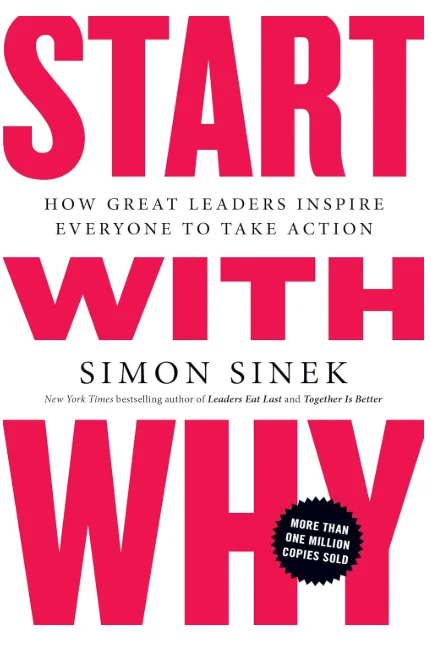
! Alt Text: Start with Why by Simon Sinek book cover business leadership
The Core Concept Start with Why: The Golden Circle
The heart of the book is a concept Sinek calls The Golden Circle. It consists of three concentric rings:
- WHY (The Center): This is your purpose, cause, or belief. Why does your organization exist? Why do you get out of bed in the morning?
- HOW (The Middle): These are your unique value propositions or proprietary processes.
- WHAT (The Outer Ring): These are the products you sell or the services you offer.
Sinek argues that “People don’t buy what you do; they buy why you do it.” Most companies communicate from the outside in (What -> How -> Why). Great leaders communicate from the inside out (Why -> How -> What). This shift in perspective is what separates commodities from brands that command loyalty.
Biology of Decision Making: Why We “Feel” It
One of the most fascinating arguments in Start with Why is biological. Sinek connects the Golden Circle to the human brain structure.
- The Neocortex corresponds to the “WHAT” level. It is responsible for rational and analytical thought and language.
- The Limbic Brain corresponds to the “WHY” and “HOW”. It is responsible for all of our feelings, such as trust and loyalty. It is also responsible for all human behavior and decision-making, but it has no capacity for language.
This explains why we often can’t explain why we love a certain brand or person—we just “feel” it is right. Sinek posits that when you start with WHY, you speak directly to the part of the brain that controls behavior.
Alt Text: The Golden Circle diagram Simon Sinek leadership concept
Case Studies Start with Why: Apple, Wright Brothers, and MLK
Sinek uses historical examples to prove his point, though he leans heavily on a few key figures:
- Apple: They didn’t just sell computers (“What”). They challenged the status quo (“Why”). Their marketing was never about gigabytes; it was about “Thinking Different.”
- The Wright Brothers: They were up against Samuel Pierpont Langley, who had funding, education, and media attention. But Langley wanted fame (What), while the Wright Brothers wanted to fly (Why).
- Martin Luther King Jr.: Sinek notes that he gave the “I Have a Dream” speech, not the “I Have a Plan” speech. He rallied people around a shared belief, not a policy paper.
Critical Analysis: Is It Repetitive?
While the core message is revolutionary, the book itself has faced criticism for being repetitive. Sinek tends to hammer the same point home using the same examples (Apple is mentioned incessantly) throughout the chapters.
Some readers might feel that the concept could have been explained in a long essay rather than a full-length book. However, the repetition serves a purpose: it drills the mindset into the reader. It forces you to constantly re-evaluate your own motivations.
Final Verdict Start with Why
Start with Why is an essential read for anyone in a leadership position, entrepreneurs, or marketers. It provides a timeless framework for building a brand that lasts.
While the prose can be repetitive, the “Golden Circle” is a tool that, once learned, cannot be unlearned. It will change the way you write emails, pitch products, and lead teams. If you want to inspire action rather than just manipulate it, this book is your blueprint.
Frequently Asked Questions (FAQ)
Q: Is Start with Why just for business leaders? A: No. While it is categorized under Self Development & Business, the concept of “Why” applies to personal career growth, job hunting, and even parenting. It helps anyone find their purpose regardless of their job title.
Q: Can I just watch the TED Talk instead? A: The original TED Talk is an excellent summary (18 minutes) and remains one of the most-viewed videos of all time. However, the book dives deeper into the how and provides much more context on the biology of decision-making. We recommend watching the video first, then reading the book to master the application.
Q: Does Simon Sinek have other books? A: Yes. Sinek has expanded his framework in books like Leaders Eat Last and The Infinite Game. You can explore his full bibliography and courses on Simon Sinek’s official website to see how his philosophy has evolved.