🧬 Book DNA
- 🧠 Mood: Inspiring • Provocative • Informative • Practical
- 🚀 Pacing: Fast-paced / Page-turner
- 🧩 Complexity: Easy Read / Light
- 🎯 Perfect For: Deep Thinking • Gift • Self-Improvement • Morning Coffee
📑 Table of Contents
- Introduction: Why Your Mindset Matters More Than Your Math
- 1. No One Is Crazy: The Role of Personal Experience
- 2. Luck and Risk: The Invisible Forces of Wealth
- 3. The Power of Compounding: Why Time is Your Best Asset
- 4. Getting Rich vs. Staying Rich
- 5. The Concept of “Enough”: Fighting the Goalpost Shift
- 6. Freedom: The Highest Dividend Money Pays
- 7. The Man in the Car Paradox
- 8. Room for Error: The Margin of Safety
- 9. Comparing Housel to Other Financial & Strategic Giants
- 10. Final Verdict: A Masterclass in Wealth Mindset
Introduction: Why Your Mindset Matters More Than Your Math
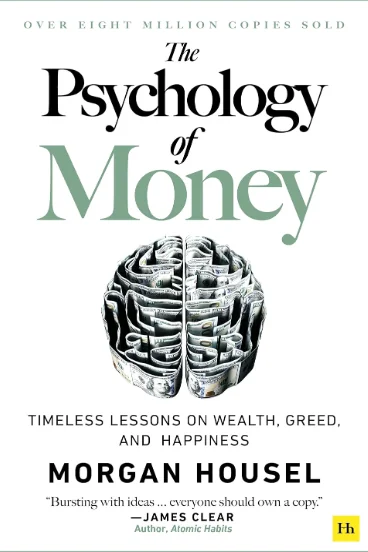
The Psychology of Money by Morgan Housel Review must start with a fundamental truth: doing well with money isn’t necessarily about what you know. It’s about how you behave. And behavior is hard to teach, even to really smart people. Morgan Housel, a partner at The Collaborative Fund and a former columnist at The Motley Fool, explores the strange ways people think about wealth, greed, and happiness.
This The Psychology of Money by Morgan Housel Review dives into 19 short stories that explain why financial success is a soft skill, not a hard science. While we are taught to think about money like physics—with rules and laws—in the real world, people make financial decisions at the dinner table, influenced by their own unique history, ego, and pride.
1. No One Is Crazy: The Role of Personal Experience
A key takeaway in this The Psychology of Money by Morgan Housel Review is that your personal experience with money makes up maybe 0.00000001% of what’s happened in the world, but 80% of how you think the world works. Someone who grew up during high inflation looks at investments differently than someone who grew up during a bull market.
Housel argues that “no one is crazy”. People make decisions based on the information they have and their unique mental models of how the world operates. Understanding this is the first step toward financial empathy and better decision-making.
2. Luck and Risk: The Invisible Forces of Wealth
In this The Psychology of Money by Morgan Housel Review, we explore the twin pillars of luck and risk. Housel points out that nothing is as good or as bad as it seems. Success is often a mix of hard work and being in the right place at the right time.
- Luck: The invisible force that helps you succeed despite your mistakes.
- Risk: The invisible force that can ruin you despite your best efforts.
The book encourages readers to focus less on specific individuals (like Bill Gates) and more on broad patterns of behavior that lead to success.
3. The Power of Compounding: Why Time is Your Best Asset
Warren Buffett is a legend, but as this The Psychology of Money by Morgan Housel Review highlights, his secret isn’t just being a good investor—it’s being a good investor for three-quarters of a century.
Compounding is like a snowball rolling down a hill. Most of the gains happen at the very end. If you want to do better as an investor, the single most powerful thing you can do is increase your time horizon.
4. Getting Rich vs. Staying Rich
There are a million ways to get rich, but only one way to stay rich: a combination of frugality and paranoia. In this The Psychology of Money by Morgan Housel Review, Housel explains that staying rich requires “survival” mindset. You must be able to endure the inevitable volatility of the markets without being forced to sell your assets.
5. The Concept of “Enough”: Fighting the Goalpost Shift
One of the most profound sections of The Psychology of Money by Morgan Housel Review deals with the social comparison that leads to greed. Wealth is what you don’t see—the cars not purchased and the diamonds not bought.
Housel warns that the hardest financial skill is getting the goalpost to stop moving. If your expectations grow faster than your income, you will never feel wealthy, regardless of how many zeros are in your bank account.
6. Freedom: The Highest Dividend Money Pays
The highest form of wealth is the ability to wake up every morning and say, “I can do whatever I want today”. This The Psychology of Money by Morgan Housel Review emphasizes that money’s greatest intrinsic value is the ability to give you control over your time.
[Image showing a pyramid of wealth where “Time Control” is at the peak]
7. The Man in the Car Paradox
We often buy expensive things to signal to others that we are successful. However, Housel points out the “Man in the Car Paradox”: you think people will admire you for your expensive car, but they don’t even look at you—they only imagine themselves in that car. Humility, kindness, and empathy will bring you more respect than horsepower ever will.
8. Room for Error: The Margin of Safety
In any financial plan, the most important part of the plan is to have a plan for when the plan isn’t going according to plan. This The Psychology of Money by Morgan Housel Review stresses the importance of a margin of safety. You must be able to survive a 30% or 50% drop in the market without it ruining your life.
9. Comparing Housel to Other Financial & Strategic Giants
To give you a full perspective in this The Psychology of Money by Morgan Housel Review, let’s compare his logic to other authors on our site:
- Vs. Principles by Ray Dalio: Dalio systemizes decisions into “machines,” while Housel argues that human emotion makes a perfect “machine” impossible in finance.
- Vs. Factfulness by Hans Rosling: Rosling uses data to show the world is better; Housel uses data to show why we feel so stressed about our money despite progress.
- Vs. Influence by Robert Cialdini: Cialdini shows how others manipulate our choices; Housel shows how our own ego is our biggest manipulator.
10. Final Verdict: A Masterclass in Wealth Mindset
As we conclude this The Psychology of Money by Morgan Housel Review, it is clear that this book is essential reading for anyone living in a capitalist society. It is simple, elegant, and packed with wisdom that will change how you think about every dollar you earn. Success in money is 80% behavior and only 20% head knowledge.