🧬 Book DNA
- 🧠 Mood: Inspiring • Provocative • Informative • Practical
- 🚀 Pacing: Medium
- 🧩 Complexity: Moderate
- 🎯 Perfect For: Deep Thinking • Gift • Self-Improvement • Career Growth
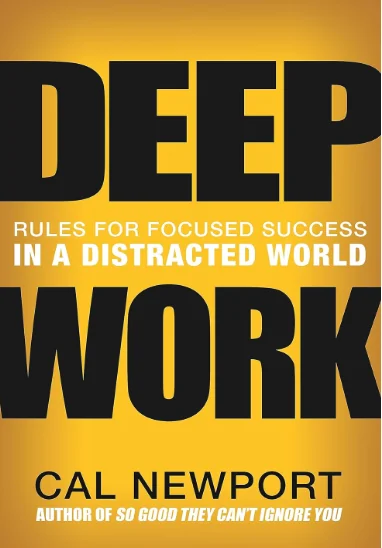
Table of Contents
- 🧬 Book DNA
- Introduction: The Superpower of the 21st Century
- 1. What is Deep Work? Defining the Core Hypothesis
- 2. The Four Philosophies of Deep Work
- 3. The Scientific Benefits of Depth: Myelin and Attention Residue
- 4. The 4 Rules for Focused Success
- Rule 1: Work Deeply
- Rule 2: Embrace Boredom
- Rule 3: Quit Social Media
- Rule 4: Drain the Shallows
- 5. Critical Expert Reviews and Endorsements
- 6. Comparison: Deep Work vs. Other Growth Systems
- Conclusion: A Manifesto for the Future of Work
Introduction: The Superpower of the 21st Century
In an era of constant digital noise and “AI slop,” the ability to focus without distraction is becoming increasingly rare and, consequently, increasingly valuable. Deep Work by Cal Newport Book Review explores what Newport calls the “superpower of the 21st century”: the capacity to concentrate on cognitively demanding tasks. Cal Newport, a computer science professor at Georgetown University and a New York Times bestselling author, argues that we have traded depth for “shallow work”—email, social media, and endless meetings that provide the illusion of productivity without creating real value.
This Deep Work by Cal Newport Book Review dives into the proven framework for achieving “focused success in a distracted world”. With millions of copies sold and translations in over 35 languages, this modern classic has sparked a worldwide conversation about the true costs of fractured attention. As Mel Robbins aptly put it, “I’m handing you the answer to the overwhelm you feel, and his name is Dr. Cal Newport”.
1. What is Deep Work? Defining the Core Hypothesis
Deep work is defined as professional activities performed in a state of distraction-free concentration that push your cognitive capabilities to their limit. These efforts create new value, improve your skill, and are hard to replicate. Conversely, shallow work is non-cognitively demanding, logistical-style work, often performed while distracted.
The “Deep Work Hypothesis” suggests that the ability to perform deep work is becoming increasingly rare at exactly the same time it is becoming increasingly valuable in our economy. The Economist calls deep work the “killer app of the knowledge economy” because it is only by concentrating intensely that you can master a difficult discipline or solve a demanding problem.
2. The Four Philosophies of Deep Work
Newport doesn’t offer a one-size-fits-all approach. In this Deep Work by Cal Newport Book Review, we examine the four different depth philosophies:
- The Monastic Philosophy: Maximizing depth by eliminating or radically minimizing shallow obligations. Think of a writer retreating to a cabin to finish a manuscript.
- The Bimodal Philosophy: Dividing your time into clearly defined stretches for deep pursuits, leaving the rest for everything else. Ezra Klein of The Ezra Klein Show uses this by preserving mornings for sustained, creative work.
- The Rhythmic Philosophy: Transforming deep work into a regular habit, such as 90 minutes of focus every single morning before the rest of the world wakes up.
- The Journalistic Philosophy: Shifting into a deep state whenever you have small blocks of free time. This is typically reserved for experienced practitioners.
3. The Scientific Benefits of Depth: Myelin and Attention Residue
Why is depth so powerful? Newport draws on neuroscience to explain that intense focus triggers the production of myelin—a fatty tissue that wraps around neurons, allowing cells to fire faster and more cleanly. By focusing intensely on a specific skill, you are literally cementing the neural pathways associated with that skill, facilitating fast, powerful learning.
Furthermore, deep work helps avoid “attention residue.” When you switch from Task A (checking email) to Task B (writing a report), your attention doesn’t immediately follow. A residue of your attention remains stuck on the previous task, significantly reducing your cognitive performance on the new one.
4. The 4 Rules for Focused Success
The practical core of Deep Work by Cal Newport Book Review is built around four rigorous rules designed to reclaim your mental powers:
Rule 1: Work Deeply
You must build rituals and routines to enter a state of focus. This includes deciding where you will work, how long you will work, and how you will support your work (e.g., no internet, specific environmental cues). Daniel Pink recommends thinking of this as “calisthenics for your mind”.
Rule 2: Embrace Boredom
Concentration is a muscle. If every time you feel bored, you reach for your phone for a quick hit of dopamine, you are training your brain to be incapable of focus. You must cultivate boredom to give the mind the space required for creative thinking.
Rule 3: Quit Social Media
Newport suggests applying the “Law of the Vital Few” to your digital habits. Identify the core tools that actually contribute to your professional and personal goals and discard the rest. Derek Sivers notes that this rule alone, with its challenge to the “Any-Benefit” mindset, is worth the price of the book.
Rule 4: Drain the Shallows
Reduce the amount of shallow work in your schedule. This involves “fixed-schedule productivity”—scheduling every minute of your day and finishing work by a set time to eliminate time wasted switching between tasks.
5. Critical Expert Reviews and Endorsements
This Deep Work by Cal Newport Book Review would be incomplete without mentioning its impact on the elite:
- Seth Godin: “Cal Newport is a clear voice in a sea of noise… We need brave work, work that happens when we refuse to avert our eyes”.
- Adam Grant: “DEEP WORK makes a compelling case for cultivating intense focus and offers immediately actionable steps”.
- The Wall Street Journal: “Mr. Newport resists the corporate groupthink of constant connectivity without seeming like a curmudgeon”.
6. Comparison: Deep Work vs. Other Growth Systems
To contextualize this Deep Work by Cal Newport Book Review, we look at its peers in our library:
- Vs. Atomic Habits: James Clear focuses on the mechanics of building routines; Newport focuses on the cognitive intensity within those routines.
- Vs. The Psychology of Money: Morgan Housel deals with the mindset of wealth; Newport deals with the high-value labor required to produce that wealth.
- Vs. Principles: Ray Dalio focuses on high-level corporate systemization; Newport focuses on the ground-level execution of difficult tasks.
Conclusion: A Manifesto for the Future of Work
As we conclude this Deep Work by Cal Newport Book Review, it is clear that this is more than just a productivity book—it is a manifesto for a more meaningful, focused life. In a world that rewards the superficial, the ability to go deep is the ultimate competitive advantage. Depth isn’t at odds with a full life; it facilitates it. By embracing depth, you don’t just work better; you live better.