🧬 Book DNA
- 🧠 Mood: Dark • Tense • Sad • Provocative • Informative
- 🚀 Pacing: Fast-paced / Page-turner
- 🧩 Complexity: Moderate
- 🎯 Perfect For: Deep Thinking • Gift
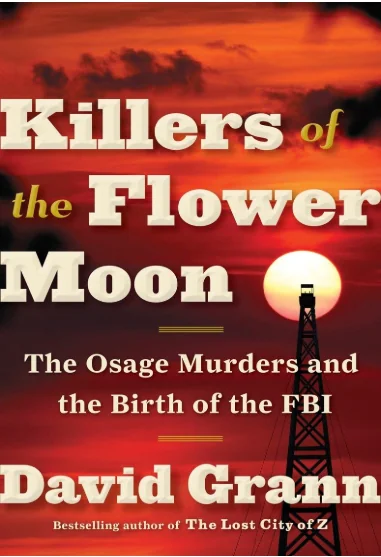
In this in-depth Killers of the Flower Moon review, we explore why David Grann’s non-fiction masterpiece is being hailed as one of the most important books of the century.
In the 1920s, the richest people per capita in the world were members of the Osage Nation in Oklahoma. Then, one by one, they were murdered. This narrative non-fiction is not just a whodunit; it is a searing indictment of institutional corruption and a chilling origin story of the FBI.
#1 NEW YORK TIMES BESTSELLER • NATIONAL BOOK AWARD FINALIST • NOW A MARTIN SCORSESE PICTURE
A Kirkus Reviews Best Nonfiction Book of the Century • A Los Angeles Times Best Nonfiction Book of the Last 30 Years
Most true crime books focus on a single anomaly—a serial killer acting alone or a crime of passion. Killers of the Flower Moon presents something far more terrifying: a conspiracy so vast it implicates an entire community. If you are looking for a Killers of the Flower Moon review that dives deep into the historical context without spoiling the ending, you are in the right place.
Table of Contents
- 🧬 Book DNA
- The Context: The Curse of Black Gold. Killers of the Flower Moon review.
- The Reign of Terror. Killers of the Flower Moon review.
- Enter the FBI and Tom White. Killers of the Flower Moon review.
- Killers of the Flower Moon Review: Writing Style. Killers of the Flower Moon review.
- Critical Acclaim
- The Third Chronicle: A Deeper Conspiracy. Killers of the Flower Moon review.
- About the Author. Killers of the Flower Moon review.
- Final Verdict. Killers of the Flower Moon review.
- Who Should Read This?
The Context: The Curse of Black Gold. Killers of the Flower Moon review.
To understand the horror of the Osage Reign of Terror, one must first understand the irony of their wealth. In the late 19th century, the Osage people were driven from their ancestral lands in Kansas onto a rocky, presumably worthless reservation in northeastern Oklahoma. It was a final insult from a government intent on marginalization.
But that “worthless” land sat atop some of the largest oil deposits in the United States. Since the Osage retained the mineral rights to their land, the oil boom of the early 20th century made them fabulously wealthy. Grann vividly paints the picture of this surreal era: Osage families building terra-cotta mansions, employing white servants, and riding in chauffeured automobiles, while the white settlers around them looked on with a toxic mix of envy and racism.
However, this wealth came with strings attached. The U.S. government, deeming the Osage “incompetent” to handle their own money, set up a deeply corrupt guardianship system. Local white men—lawyers, businessmen, politicians—were assigned to manage the finances of Osage citizens. It was a system designed for exploitation, and it laid the groundwork for murder.
The Reign of Terror. Killers of the Flower Moon review.
The heart of Grann’s narrative focuses on the family of Mollie Burkhart, an Osage woman married to a white man named Ernest Burkhart. Mollie is the emotional center of the book—a woman of dignity and grace witnessing her world collapse.
The killings began slowly. In May 1921, the body of Mollie’s sister, Anna Brown, was found in a ravine, shot in the back of the head. Shortly after, another Osage man, Charles Whitehorn, was found dead. Then came the poisoning of Mollie’s mother, Lizzie. The terror escalated when Mollie’s other sister, Rita, and her husband were killed when their house was bombed with nitroglycerin.
Grann does a masterful job conveying the claustrophobia of the reservation. The Osage were being hunted by people they knew—neighbors, doctors, even spouses. For readers of this Killers of the Flower Moon review, it is important to note that this section reads like a thriller, yet every terrifying detail is factually true.
Enter the FBI and Tom White. Killers of the Flower Moon review.
As the death toll rose, the case landed on the desk of J. Edgar Hoover. He turned to Tom White, a former Texas Ranger, to lead the investigation.
White assembled an undercover team to infiltrate the region. What they uncovered was a web of deceit shocking in its calculation. The perpetrators were marrying into Osage families to inherit their “headrights” (oil money) before eliminating them. For more context on this era, you can read the FBI’s official history of the Osage Murders.
Killers of the Flower Moon Review: Writing Style. Killers of the Flower Moon review.
David Grann is known for his immersive research. He has a gift for finding human details in dry archival documents. The prose is restrained yet evocative, resisting the temptation to sensationalize the violence.
The structure is brilliant:
- Part One: Sets the mystery from Mollie Burkhart’s perspective.
- Part Two: Follows the FBI procedural.
- Part Three: Offers the author’s modern-day investigation.
Critical Acclaim
“Disturbing and riveting…. Grann has proved himself a master of spinning delicious, many-layered mysteries that also happen to be true…. It will sear your soul.” — Dave Eggers, NYT Book Review
“A masterful work of literary journalism crafted with the urgency of a mystery…. It offers up the Osage killings as emblematic of America’s relationship with its indigenous peoples.” — The Boston Globe
The Third Chronicle: A Deeper Conspiracy. Killers of the Flower Moon review.
If the book ended with the FBI’s success in closing the Burkhart case, it would be a satisfying true crime story. But Grann goes further. In the book’s final section, he conducts his own modern-day investigation.
Grann uncovers evidence suggesting that the “Reign of Terror” was much wider and lasted much longer than officially acknowledged. The evil wasn’t limited to one crime boss; it was a culture of killing. Doctors, morticians, and guardians were quietly murdering their charges for money. It is a devastating conclusion that denies the reader a clean, happy ending.
About the Author. Killers of the Flower Moon review.
David Grann is a giant in the world of narrative non-fiction. He is the author of the #1 New York Times bestsellers Killers of the Flower Moon and The Lost City of Z. His work has garnered several honors, including a George Polk Award and an Edgar Allan Poe Award. Grann is known for his immersive research style, often spending years digging through archives to uncover forgotten chapters of history.
Final Verdict. Killers of the Flower Moon review.
Killers of the Flower Moon is one of the most important non-fiction books of the 21st century. It is a gripping mystery, a courtroom drama, and a historical corrective rolled into one.
It is not an easy read; the cruelty on display is heartbreaking. But it is a necessary one. For fans of history, true crime, or simply great American literature, this book is mandatory reading.
Who Should Read This?
- True Crime Fans: If you loved In Cold Blood or The Devil in the White City, this belongs on your shelf.
- History Buffs: Specifically those interested in the American West, the Jazz Age, or the history of federal law enforcement.
- Investors & Thinkers: While not a finance book, it offers a stark lesson on the corrupting power of unchecked greed.
Recommendation: Buy the physical copy. The photos included in the book—of the FBI agents, the Osage victims, and the desolate landscape—add a haunting layer of reality to the narrative.
If you enjoy historical narratives that read like thrillers, be sure to check out our other reviews in the History & Thriller section.